“Who wants a choripán?”
That was my father’s call whenever the first chorizos came off the parrilla.
The larger cuts were still cooking. The adults could continue talking and waiting. But as soon as we heard that question, all the children appeared around the grill.
For me, that is where choripán begins: not as a recipe, but as the first reward of the asado.
I also remember eating it with my father at the carritos along the Costanera. I grew up in Adrogué, and when we drove into central Buenos Aires we would sometimes stop beside the river. There was smoke coming from the small grills, the smell of chorizo in the air and people eating with their hands beside the car.
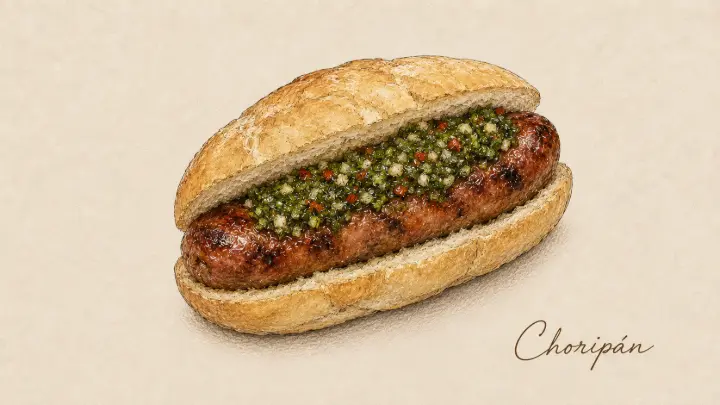
It was simple. A grilled chorizo, bread and chimichurri.
It still is.
Argentina’s real fast food
When McDonald’s arrived in Argentina, it changed the way many people ate. Hamburgers spread everywhere. International chains occupied the shopping centres and city centres.
But they never displaced the choripán.
They could not, because choripán was already doing the same job in a much more Argentine way. It was quick, hot, affordable and easy to eat standing up. It belonged at roadside grills, political gatherings, festivals and carts around the Bajo and the Costanera.
It also had another life inside the family asado. The choripán was not competing with the main cuts. It came first, while the vacío and ribs still needed time.
That is why I do not see it merely as a sausage sandwich. It belongs equally to the street and the family parrilla. Very few foods move so naturally between those worlds.
Who invented choripán?
There is a convenient story that choripán was invented by gauchos who began putting grilled chorizo inside bread during rural asados in the nineteenth century.
It is possible. It also makes almost too much sense.
But there is no reliable date, named inventor or single place where we can say the first choripán was made. Córdoba has its claims. Buenos Aires has made it part of its street culture. Uruguay also has a deep choripán tradition, as do other countries across South America.
The most honest version is less tidy. Chorizo was already being cooked over fire in the Río de la Plata, bread made it practical to hold and eat, and at some point the combination became so obvious that it no longer needed an inventor.
Even the name is direct: chori from chorizo, pan from bread.
It probably did not begin as somebody’s culinary creation. It began because somebody was hungry beside a fire.
What makes an Argentine chorizo different?
Not every chorizo belongs in a choripán.
Spanish chorizo is the source of endless confusion outside Argentina. Many Spanish versions are cured, heavily seasoned with pimentón and intended to be sliced or used in cooking. They can be excellent, but they are not the fresh parrilla chorizo I want inside bread.
Italian, French and British sausage traditions are too varied to reduce to one style, but many of the sausages I find in Britain are narrower and more finely minced. Their texture can be soft and uniform. Some feel closer to a sausage filling than to the coarse, substantial chorizo I grew up eating.
An Argentine parrilla chorizo is fresh, wide and coarsely ground. You should be able to see and feel small pieces of meat. It should not have the smooth texture of an industrial sausage.
In Argentina, a common formula is 40% beef, 40% pork and 20% fat. Beef was historically more available and affordable than pork, so the mixture made economic as well as culinary sense.
But in my opinion, a really good chorizo can be entirely pork: 80% pork meat and 20% pork fat.
That is the formula I use.
I grind the meat through an 8 mm plate. A 10 mm plate gives an even more rustic texture, while the fat can be cut through a 12 mm plate so that it remains more clearly defined. I stuff the mixture into natural hog casings with a diameter of 36/40 mm.
Those measurements are not incidental. The coarse grind and wide casing are part of the identity of the chorizo. If I make it thin and finely minced, then add chimichurri at the end, I have not made an Argentine chorizo. I have made a British sausage wearing an Argentine hat.
It took me two years to make the chorizo I wanted
Most people in Argentina do not make chorizos every time they prepare an asado. They buy them from a butcher they trust.
That is what I would have done too.
But in London, I could not find a supplier making the chorizo I wanted. The size was wrong, the texture was wrong or the flavour reminded me of a British sausage rather than an Argentine parrilla.
So I started making my own.
It took me almost two years to produce one I was genuinely happy with. Some early batches had a particularly frustrating problem: the chorizo tasted dry, but when I cut it open, fat poured out.
The fat was there. It simply was not staying bound to the meat.
Getting it right was not just a question of adding more fat. I had to control the temperature during grinding and mixing, develop the proper bind and cook the chorizo without forcing the fat out before the meat was ready.
This is the strange thing about simple food. The finished sandwich has three principal components, but that does not mean any one of them can be careless.
How I cook choripán
I cook the chorizo whole over the parrilla.
Only once it is cooked do I cut it lengthways and open it like a butterfly—a la mariposa—before putting it into the bread. If I am serving small children, I return it to the grill open for a final cook. With pork sausage, “probably cooked” is not a category I accept.
I prefer the butterfly cut even when cooking for adults. It sits better in the bread, is easier to eat and creates more surface for the chimichurri to penetrate.
The bread matters. It should be similar to Argentine pan francés: a roll with a light crust, but not a hard baguette that fights back with every bite. The inside needs enough structure to absorb the juices and sauce without collapsing.
Chimichurri is not optional for me.
Salsa criolla is also welcome. Some people add lettuce and tomato and turn it into a more complete sandwich. They are allowed to do it. I just do not think it improves the choripán.
Chorizo, bread and chimichurri are enough.
Serving choripán in London
For many guests at my events in London, choripán is their first contact with Argentine asado.
They may be waiting for the steak or wondering which of the larger cuts will be served next. Then I give them a chorizo opened inside bread, with chimichurri soaking into the surface, and the reaction is almost always much bigger than they expect.
People go mad for it.
Perhaps that is because choripán does not require a long explanation before you eat it. I can talk about the casing, the grind, the fat ratio and the two years it took me to get my recipe right. All of that matters to me as a cook.
But the person holding the sandwich only needs to take a bite.
Then I hear the same question that followed my father around the parrilla:
“Is there another one?”