In my family, matambre appeared at Christmas without anybody formally deciding who would make it.
There was always an aunt who arrived carrying one.
Argentine Christmas is usually a large family gathering, and everyone brings something to the table. Vitel toné. Russian salad. Matambre arrollado. These are dishes that can be prepared in advance and eaten cold, which makes a great deal of sense when Christmas falls in the middle of the Argentine summer.
You can buy slices of industrially made matambre from a deli and put them in a sandwich. It is not the same.
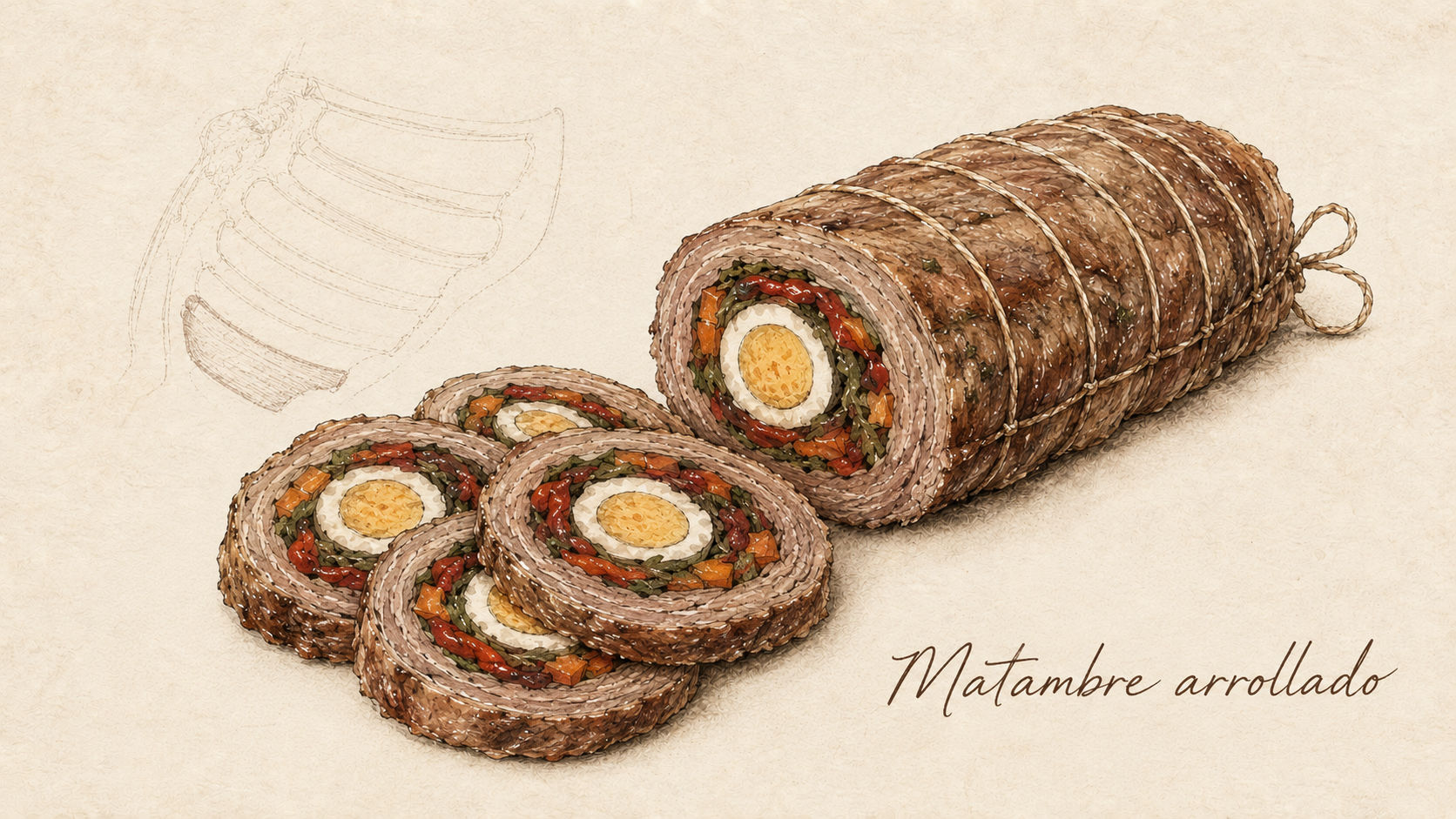
For me, matambre is homemade food. Somebody opens the meat on the kitchen table, covers it with egg, carrot, red pepper and greens, rolls it tightly and ties it. Every family has its version, and everyone knows whose matambre they hope will arrive at Christmas.
Where is matambre on the cow?
Matambre is a long, thin and flat muscle found immediately beneath the skin, covering much of the outside of the ribs and extending from around the shoulder towards the flank.
It is not simply another name for flank steak.
The official Argentine beef nomenclature describes it as the músculo cutáneo: a superficial muscle attached beneath the skin and covering most of the external face of the rib section. It has to be carefully removed by hand with a knife. That definition is technical, but it explains the cut perfectly. Matambre is the thin layer between the hide and the ribs.
This also explains why translating Argentine cuts into British or American names causes so much trouble. Animals do not change from one country to another, but butchery does. One system preserves a muscle as an individual cut; another leaves it attached to a larger section or trims it away for a different use.
On the outside of a complete rib section, beneath where the skin was, I find the matambre. On the inside are the entrañas, the vacío and the rest of the rib and flank structure.
Once you understand that, the cut becomes much easier to recognise. Asking a butcher for “Argentine matambre” is often less useful than showing exactly where it sits.
Why is it called matambre?
The name is one of those pieces of Spanish that almost explains itself: mata-hambre—“hunger killer.”
The Royal Spanish Academy traces the word directly to matar and hambre, and defines the cut as the layer of meat removed from between the hide and the ribs of cattle or pigs.
The traditional story goes further. During the nineteenth century, when cattle were slaughtered and the more valuable parts were prepared for sale or export, this thin and less prestigious piece was given to the workers. It cooked quickly over the embers and killed their hunger after a long day.
It is a good story, and it fits the name. It is also repeated much more often than it is documented, so I would not present every detail as proven history. What we do know is that the word and the food are not recent inventions. Esteban Echeverría was already writing about matambre in 1837, playing with its meaning and treating it as something unmistakably connected to Río de la Plata food culture.
The name survived because it is perfect. It is direct, practical and slightly dramatic. Very Argentine.
Why matambre is difficult to find in Britain
I do not normally find matambre waiting for me as a separate cut in a London butcher’s display.
British butchers do not usually remove and sell it in the Argentine way. It is often left with the flank or trimmed and used for mince and burgers. From the butcher’s point of view, there may be no reason to spend time separating a thin, unfamiliar and relatively tough piece that most customers will not recognise.
That is why I buy a much larger section, often the whole rib section with the flank attached, and break it down myself.
Finding the matambre still there always feels like discovering something valuable that everybody else has overlooked. I remove it carefully, save it and already know what I am going to make with it.
This is one of the realities of cooking Argentine food in Britain. Learning the English name is not enough, because sometimes there is no exact retail equivalent. You need to understand the anatomy of the animal and the logic of both butchery systems.
The official Argentine description of the cut even notes that the matambre covers the outside of the rib section and must be removed manually with a knife. In Argentina, preserving it is normal. Here, you may have to ask for the complete section before the butcher turns it into something else.
Matambre arrollado and the Argentine Christmas table
Matambre can be cooked on the parrilla, in the oven, in milk or a la pizza, covered with tomato and melted cheese. But matambre arrollado occupies a different place.
It belongs to Christmas.
The meat is spread flat and filled. In my version, the filling includes hard-boiled eggs, carrots, red pepper and spinach or parsley. Then I roll it tightly, wrap it in a clean kitchen cloth, tie it and cook it gently in broth.
Once cooked and chilled, it can be cut into slices that reveal the filling inside. No two slices look exactly alike. That is part of its charm.
It works on a crowded Christmas table because it does not demand attention at the last moment. It can sit beside vitel toné and Russian salad, be eaten on its own or disappear into sandwiches later. It is generous food made to be shared.
There is also something very personal about the filling. One family uses spinach; another uses parsley. Some add peas. Some put in whole eggs lined up through the centre; others distribute them differently. These are small differences until somebody tells an aunt that another family makes it better.
Then they become serious.
The matambre I make in London
I still prepare it the way I understand matambre should be made: by hand.
I clean and open the piece, add the filling, roll it inside a cloth and tie it before lowering it into broth. The cloth helps the roll keep its shape while it cooks. Afterwards it needs time to cool and settle before slicing.
But I do not save every matambre for Christmas. I also use it to make Tucumán-style matambre empanadas. In Tucumán, empanadas are traditionally made with beef cut by knife rather than minced, and matambre gives them exactly the texture they should have. It is another example of what happens with this cut in Argentina: something that could easily be treated as a leftover becomes the centre of the dish.
When I make one, I usually save some for Umberto, an Argentine friend in London who makes medialunas. He loves matambre. I understand the exchange: an Argentine who makes medialunas should not be left without a few slices when another Argentine has managed to find a proper matambre.
That small ritual probably says more about the dish than a perfect definition could.
Matambre began as a cut that was easy to overlook. In Britain it often disappears before it ever reaches the counter. But once I separate it from a complete rib section, roll it and put it on a table, it becomes the opposite of a leftover.
It becomes the dish everyone recognises.
You can find my full method in the matambre arrollado recipe, including how I prepare the filling, tie the roll and cook it in broth.
And if your family makes it differently, I would like to hear how. With matambre, the variations are not mistakes. They are usually the part of the recipe that tells you where somebody comes from.